Sunday, July 6, 2014

Why Snake Form?

Most people in the local Kung Fu community know me for performing Snake Form in tournaments (before I stopped competing) and performances.  People that did not know me in the early days of teaching probably are not aware of why this started.  I know so many amazing forms from Chan Tai San that could have been the form of choice but that is the one that ended up being my signature form.  Here is the quick story behind it.

The year was 1989 and I had been teaching my class for about a year.  We were happy to perform and promote our classes to the public whenever the opportunity arose.  One request that year was for a Kung Fu demo during a Chinese New Year celebration.    Of course we were happy to perform at the celebration.  The follow up request was to see if we would be able to include a Snake Form to celebrate the Year of the Snake.  Sifu had taught me a Snake Form and there was enough time to fine tune it to an acceptable level for performance so I agreed.  The performance went off as planned and I felt very comfortable with the form.

The following weekend there was a tournament that the class decided to attend so I pulled out the Snake Form again because it was the one I was focused on during my most recent training.  I did well in the tournament and with a healthy schedule of other tournaments coming up in the following weeks, I just decided to ride it for the stretch.  That stretch became a year and the next thing I know it became my form of choice.  I did throw in other forms on occasion just for the change but always returned to Snake.

There were a few things that I think caused me to keep using the form:

  • It felt like it suited my body type
  • It became a bit of a challenge to prove that softer forms can still do well
  • A few instructors that saw me at tournaments encouraged me to keep going with it because it was a nice break from seeing the same old forms all the time
  • A very nice compliment from a person in one city that told me that the main reason they came to the tournament the second year was to see me perform again
  • Biggest reason - when Sifu came for a visit, my brother's students and I thought it would be nice to do a show for him...when I performed Snake Form, Sifu jumped up from his seat and was clapping and yelling that it was Snake Form!!  After the performance he told me how happy/surprised he was with the improvement in the form since teaching it to me.  With that kind of reaction, how could I not continue?

Friday, May 16, 2014

What Can A Kung Fu Student Do?

Every single student in a class progresses and improves...I guarantee that as long as you go to classes and put in some effort, you will improve.  The more important thing is how to maximize your training.  Each person learns at a different pace so here are some tips to help do your best.

  1. Learn something every class - This does not mean that you need to learn a new technique or a new part of your form every class.  What I mean is that you need to listen to corrections from your instructor, discover a more effective way to execute a technique that you know, remember that move that you always get stuck on, etc.
  2. Retain what you learn - Once you learn something in class, you need to ensure that you remember that for next class.  To progress you need to be able to retain your past learning and execute on them so you can focus on learning more instead of relearning something.
  3. Find your capacity - How much can you learn and retain?  This is different in every person.  Some people can learn and retain one thing each class while others might be able to learn and retain more things.  Kung Fu is not a contest so don't worry about someone else's pace.  
  4. Repeat - Repetition is the thing that will give your body the muscle memory to execute a technique or form.  Ensure that you are spending your time repeating what you learn.
  5. Question yourself - Ask yourself if you are actually doing this correctly as you practice.  Ask yourself if you understand why you are doing something.  Ask yourself what you can work on to make your techniques better.
  6. Listen - So many lessons are taught in our classes.  Instructors are teaching students, senior students are teaching junior students, fellow students are discussing techniques with each other, etc.  Listen to what is being taught and hopefully you will catch a few pieces of information that you may not have known before.
  7. Show up physically - During my career as an instructor I have been fortunate enough to be in situations where I could almost always be available for classes.  The harder part is being in the habit of going to class on days when you are tired or would prefer to be doing something else.  
  8. Show up mentally - Once you have arrived in class it is now time to prepare to focus.  Get yourself prepared to pay attention to the instructors and focus on the techniques you are working on.
  9. Be proud of yourself - You work hard and continue to improve.  Martial arts training is a journey that can last a lifetime so be sure that you remind yourself that you have continued when hundreds, thousands or millions of others did not continue after starting.   


Wednesday, March 26, 2014

Wow...My Opponent is....

When observing students working on their fighting, I often see students intimidated by level or seniority of the other student that they are going to fight with.  I was also there at one point but quickly learned that there is no reason to worry and eventually preferred to work with people who were more senior and usually better than I was for some good reasons:

  • Nobody actually wants to hurt you in class because we are all there to learn and get better
  • More senior students typically have better control of their techniques and are actually less likely to accidentally hurt you
  • Fighting with someone better than you forces you to elevate your fighting to match with your opponent's skill level
  • Senior students will often be able to see things in your fighting and be able to give you some pointers on improving your fighting
  • With mutual respect and control there is also an opportunity to learn because neither fighter is afraid to get hurt, therefore allowing you to try new techniques
  • We are all friends in class
I do recommend being more careful in tournament settings as adrenaline seems to contribute to lack of control.  I also believe that tournament fighters care less because they actually don't know you and will not have to see you in the next class.  I am not suggesting that people will try to hurt you but I have seen some things that you would not see in class.

Even with tournaments, I would encourage competitors to forget about the size or level of their opponent and look for ways to penetrate the opponent's defences that are within your own abilities.  

Sunday, March 23, 2014

Settled Into Our New Location

It has been a few weeks now and we are settled into our new location and training hard again.  For anybody who has not heard, we are now located in Mississauga, Ontario after about 14 years in our last location.  It seems like we are starting to get used to the surroundings and I am looking forward to everybody's continued success in their training.

Tuesday, July 30, 2013

Learn A Bit At A Time

Learning Kung Fu is not an exact science.  Each student learns at a different pace and has different levels of natural ability, coordination, learning aptitude, focus and self motivation.  Everybody loves learning new techniques and forms but it is important to remember to take your tome to allow your body and mind to absorb the new material.  It is natural to think that you can absorb more than you were taught but it is best to channel that energy into repetitions of the things you learned in the current and past classes.  It is almost impossible to be correct without repeated execution.  Remember to take as much joy in improving as you do in learning new.  This will greatly increase your overall result over time.

Saturday, July 27, 2013

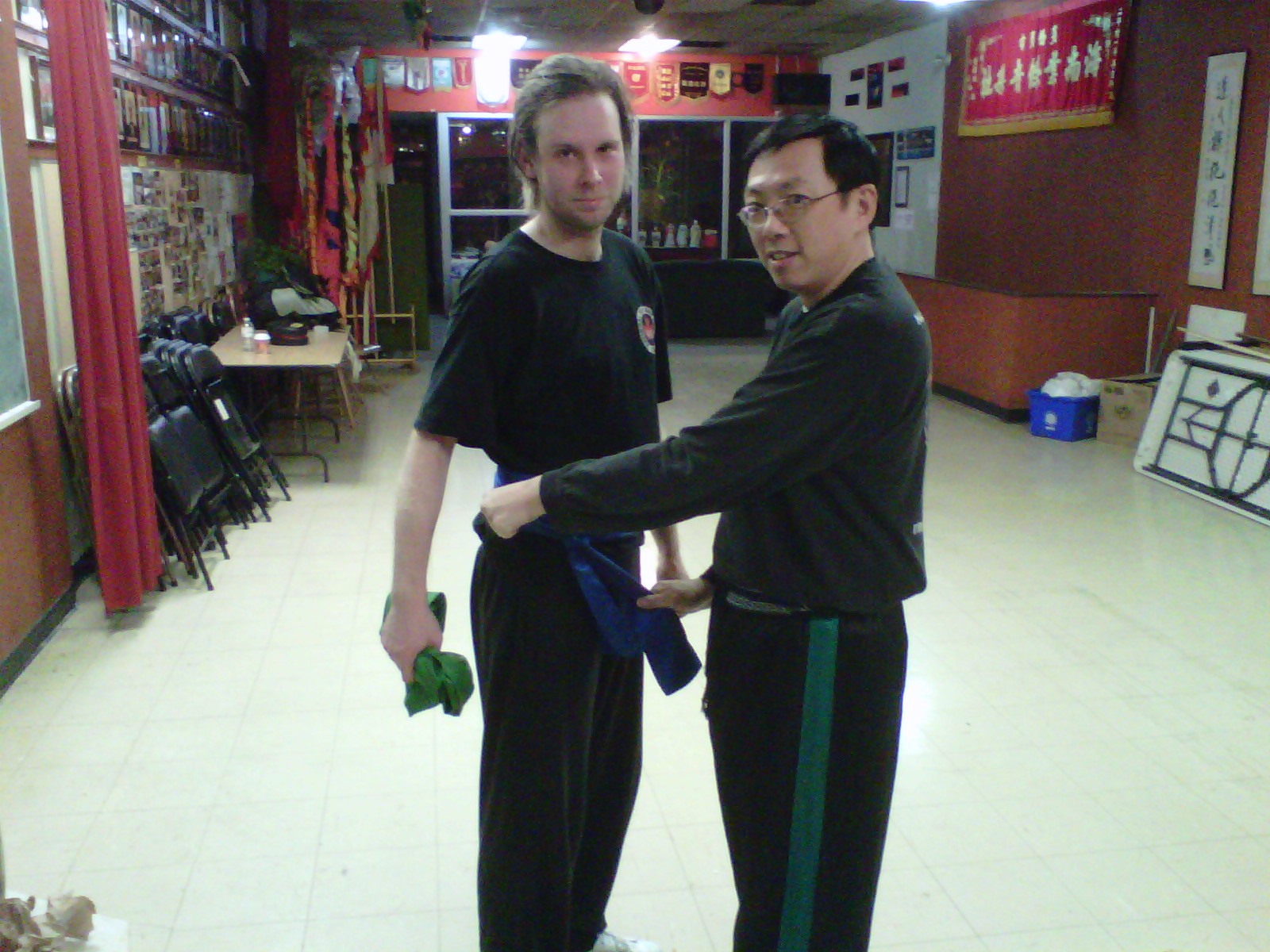
New Instructor in the School - JP


We proudly promoted JP to Instructor level on Thursday night.  Congratulations JP!!  The only question we have is whether or not you wore the new belt to work.  

Saturday, June 22, 2013

I have been away for quite some time due to work related reasons.  Now that I have a chance to return to do some writing, I took a browse through some past posts and came across this one.  We are all a bit older since I last posted so thought I would link back to it.

http://sifuchow.blogspot.ca/2009/06/as-you-get-older-in-martial-arts.html

Hopefully I will be adding more content again very soon.

Saturday, July 9, 2011

Where Have I Been?

As I discussed in a previous post, life sometimes gets in the way of other things we do. I have not had an opportunity to write for a while due to some changes in my work life. Once I get ramped up I planLink on finding time to post again.

Monday, May 23, 2011

Tournament Training

The next CCKSF Kung Fu tournament is being planned for October this year. Students that are interested in competing should start thinking about it and slowly begin to prepare.

Although it isn't necessary to do any kind of special training, it is a way to increase your chances. For anybody that is interested in trying, here are some tips on preparing.

Forms:


  1. Decide which form(s) you will be performing and make sure that it gets some exposure during your workout even on days that you are focused on other things. Just running throught the forms a couple of times continues to build on your muscle memory.

  2. Clarify any confusion you have on the techniques of your form now. This prevents trying to make late stage changes the week before a tournament.

  3. Self regulate - look at your stances, look at your body positioning, look at your techniques. The less time we spend on correcting your form, the more time we have to work on improving your form.

  4. As we get close to tournament time, shift your focus to the forms you will be using for competition. Since there are other forms with the same or similar moves in the style, it is best to avoid confusion.

  5. Prior to tournament day, make sure you are comfortable with the routine of the tournament - introduction, procedures, etc. If you are not sure, ask.

Fighting:


  1. Fighting is much more difficult to prepare for because your opponents are unknown. Start by making sure you get a bit of practice in whenever possible, even if it is just working on specific techniques instead of free sparring.

  2. Make sure to practice against various opponents instead of just one regular sparring partner. This will give you some work with different fighting personalities, different favourite moves, different sizes and different levels of aggressiveness.

  3. Vary your fighting style between aggressive and passive to give you options depending on situations that may arise during the tournament fights.

  4. As you get closer to tournament time, make sure you take some time to fight in more aggressive situations. Make sure your partner agrees and have some of the instructors watching...this will simulate some of the more aggressive tendancies that come out during the tournaments.

  5. Well before tournament day you should review the rules to make sure there are no surprises.

  6. Make sure that you are prepared to have fun and learn from the tournament whether you win or lose.

I want to be clear that this preparation is optional. The main idea is to compete to experience the atmosphere, push yourself out of your comfortable setting of your school, see what other styles do and make a few new friends so those students that choose to go without preparing can still have a valuable experience. As you gain more experience in martial arts, you will find that you can be asked to perform without much notice so it is much better to be prepared all the time.

Saturday, May 21, 2011

Qigong to Prevent Cancer Seminar

The CCKSF is putting on a seminar on Qigong to Prevent Cancer. All experience levels are welcome.

Details are on their website.

Monday, April 25, 2011

Blocking Theory

Blocking techniques are obviously very important to protect you during a fight. With a bit of work and the proper understanding of the techniques, everybody can become proficient at defending themselves. The next step is to use the blocks the way they are intended which normally means there is more than just stopping an attack.

In a past post I spoke about blocking softly. This is exactly what should be done when redirecting a strike or trying to control with a grab but there are times where you are trying to do something else with the strike. There are times when the technique is intended to be hard because you are trying to damage the striking arm or leg. Look at the blocks you are executing and determine if it is something that is intended to deflect or something that is meant to be more aggressive. With practice and/or the help of your instructors you will see when you can use blocks for the various purposes. Take some time to make some mental notes the next time you are working on your techniques and you will notice a difference in your fighting. Deflections will become harder to detect and hard blocks will become more of a distraction to your opponents. Better understanding the blocks will also help you focus on the correct angles to execute your block.

Sunday, March 6, 2011

Control Your Emotions During Fighting

Each Kung Fu student will be different when they fight and each individual will react differently when they are fighting. It's natural and completely acceptable to experience a mix of emotions when practicing fighting. It is not OK to lose control of emotions when fighting.

Newer students are often scared, anxious, apprehensive and timid when they fight. This is because fighting is probably an unknown to them. Most people have not been in many fights in their lives. Overcoming this is the first mental battle you must go through to become a decent fighter. Once you are more comfortable, you will not hesitate when executing techniques and you will become much more successful in sparring.

Depending on the student, another emotion that comes into play is pride. As we practice fighting in our class, we try to remind the students that we are all there to learn. It is not necessary to win the fight and therefore don't worry about getting hit. Learn ways to avoid getting hit the same way next time. This ties in with frustration for the same reason. Don't get frustrated because you are getting hit by your opponent during sparring...you are there to learn and find ways to get better at what you are doing.

Anger unfortunately is an emotion sometimes that creeps into Martial Arts. Accidents happen when practicing fighting and on occasion someone will get hit harder than they should during a practice session. At this point it is important to step back and remember that the class is trying to learn together and the action was not on purpose. Anger combined with competitiveness can unfortunately lead to escalation in power during fighting and lead to students getting hurt.

One last hint is to avoid being intimidated by your opponent for any reason. They may be more senior than you or stronger than you or faster than you but they are still a Martial Arts student just like you. Fighting a superior opponent is definitely a great way to improve your own fighting if you focus on the lessons learned during the fight.

Saturday, February 26, 2011

5 Reminders on Fists

Punching is one of the first and most basic techniques you will learn in martial arts. Because we learn punching early in our training careers we also have the most opportunity to practice wrong or get sloppy while performing. Here are 5 points to keep in mind when practicing.
  1. Your contact point on a punch should be your first two knuckles
  2. At the point of impact, you should be forming a straight line from your striking point, through to your elbow. The biggest mistake is to have a bent wrist at the point of impact.
  3. Try to save your torque of your arm until just before impact.
  4. Your fist should be clenched tightly at the point of impact, even if you are just practicing and not making any impact. Practice correctly to avoid accidentally striking with a partially open fist.
  5. The forming of your fist should be 3 steps. Fold the tips of your fingers down, fold your knuckle joints, and finally fold your thumbs in. To experienced martial artists, this should be natural but for new martial artists, this sequence will prevent you from folding your thumbs inside your fists.

Those that practice correctly should not have to think about these things after a short period of training correctly as your body will start to naturally perform correctly.

Monday, February 21, 2011

Lama Training In Class

We are at an interesting time in our class where a group of the students are learning Lama forms. We do this for fun and as a break from the core training in Fut Gar. For those that are not familiar with how I ended up learning from multiple instructors, I wrote about it in a past post.

I thought I would take some time to point out some differences from Fut Gar that should be kept in mind during the training:
  1. There are points in Lama forms where you will be leaning. In Fut Gar we are always keeping our body straight with no lean.
  2. You need to be in a Gung Bo for many moves. Although this is not used in Fut Gar hand forms for reasons we have discussed in class, there are reasons to use the stance in Lama.
  3. Your back hand will be extended during many techniques in Lama. In Fut Gar, we are typically pulling back to an elbow directly opposite of the attack.
  4. In Fut Gar we generate power mainly from the turning of the waist but in Lama you will notice that we will discuss other methods.
  5. We will be using a wider Ma Bo in Lama than we do in Fut Gar.
  6. You will likely find that you are burning out of energy. This is common whenever you try to do a different style because your body has not adjusted to the new way of moving.

There are some things that don't change:

  1. You should be looking at your opponent during the techniques. Of course I mean at their shoulders and head, not at their feet.
  2. You should continue to think of why you are executing techniques.
  3. Your striking and blocking surfaces will remain the same.
  4. You will still be told to lower your stances.
  5. Have fun with the training.

Sunday, February 13, 2011

Yes There Is a Purpose

With the evolution of martial arts, it is impossible to avoid changes to techniques in traditional forms over time. This could be due to imitation of another individual, incorrect execution, incorrectly remembering the technique, misunderstanding of a technique, overemphasis of a technique (changing the form to match the application of the technique), rushed learning leading to imprecision, or shortage of knowledge in the instructor leading to their own flavour of execution. In fact, I have seen instructors change forms over time to something they believe is easier to execute or "looks better" when they perform. Unfortunately, this takes away some potentially important details in the style.

Instead of changing forms, I would encourage martial artists to think about what they are doing. In my experiences, there are purposes for executing a technique a certain way and for specific hand positions. The purpose could be defensive such as defending an area of the body, striking to a blind spot as a defense (Fut Gar students will be very familiar with this concept), protecting from follow-up techniques, or as a backup in case your technique is unsuccessful. The purpose could be offensive such as setting up your next technique or could a hidden meaning. Before changing a technique, I believe it would be much more useful to ask what all the potential reasons are for doing something a certain way. This not only will help preserve your style but also take you through the exercise of self learning something you have not specifically been taught.

For those that make changes because it looks better...yes, I have heard this reason. An experienced martial artist appreciates a form done correctly and done well. Changing a few moves will not make a difference. Instead of adding flash, it is probably much better to practice your forms until you are known for your precision and outstanding execution.

Monday, January 31, 2011

James Moves Forward


Sorry about the delay but here are a few pics from James' grading. It was a long but successful night at the school.


Wednesday, January 19, 2011

Latest Grading Pics


It has been a while since I have had a chance to post but last night's grading has motivated me to log on and share the pictures. Enjoy and congratulations to Chris.


Saturday, December 18, 2010

Control of Techniques

With the smaller classes in the colder weather, we have had a couple of chances to focus classes on control of techniques during fighting. The students that have been in the advanced classes have had a chance to start working on this and hopefully picked up some interesting learning. I hope to continue with this over the next few weeks.

The main point of these exercises are:
  • If you can do something with control, you can add power later.
  • It is much easier to learn in the safer environment.
  • It will help you develop because you are less afraid to try new techniques when there is no danger of being knocked on your butt.
  • There is less escalation of strength during the fights when students know the goal is to control.
  • You will start to learn to feel the attacks that you are blocking.
  • Speed of the fight increases allowing the students to learn how to read techniques.
  • Less hesitation to throw combinations.

Some of the points we should keep in mind:

  • Stay loose.
  • Try to learn how much power is needed in your blocks to be more efficient with your energy.
  • Concede strikes - if you know that a controlled strike would have hurt you, your reaction should be appropriate (do not try to jump back at your opponent right away as this is not what would actually happen).
  • Control your emotions - getting excited will escalate the power of your strikes and ultimately the power of the fight.
  • Have fun.

Friday, November 26, 2010

Old Fut Gar Article

Thanks to James for sending this to me. I had not seen this in a long time. The Fut Gar article was an article that was posted on the wall in Master Chen's old school. The other interesting thing, I believe I actually have this particular magazine somewhere (from the cover) but was not teaching Fut Gar at the time.


Not sure how the embedding will work but hopefully you can see it.

Sunday, November 7, 2010

Frustrating But Funny

Just an fyi for any of the students who have tried to email me recently. Someone (not one of our students) sent through a couple of huge files to me and completely locked up my email account. It should be fixed soon but you probably got bounced messages if you tried to reach me in the last week or so.

How is this funny? I can only laugh because my first thought was "this is what happens when you give old Kung Fu Instructors an email address"

Be back in touch soon!!!